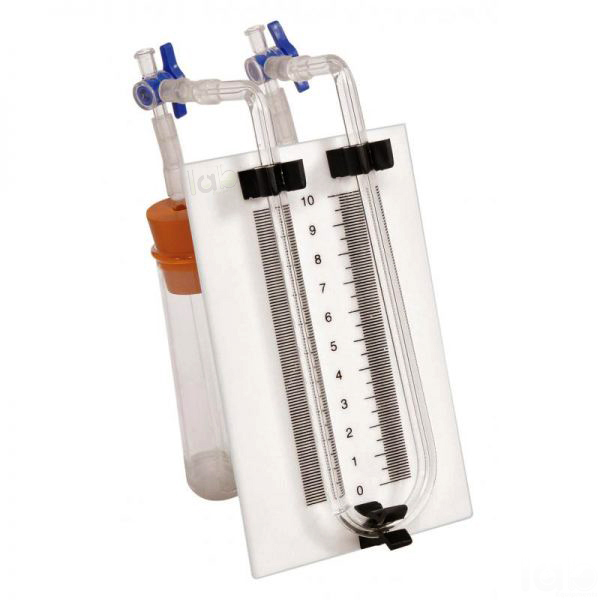
Quick Answer: Respirometer is an apparatus for comparing rates of absorption or evolution of gases by small organisms during respiration, using two stoppered glass boiling tubes connected by three-way taps to a U-shaped graduated manometer.
Last updated: October 2026
Key Features
Two stoppered glass boiling tubes on three-way taps
U-shaped graduated manometer connected to both tubes
One tube holds the organisms; the other acts as a control thermo-barometer
Potassium hydroxide in the experimental chamber absorbs the CO2 given off
Syringe for altering the manometer liquid level during setting up
Supplied with a wire basket for the organisms and a 1 mL syringe
Technical Specifications
Specification
Value
Tubes
Two stoppered glass boiling tubes
Connections
Three-way taps
Manometer
U-shaped, graduated
Accessories
Wire basket, 1 mL syringe
About This Product
Small organisms are supported in a wire basket inside the experimental tube, where the carbon dioxide they give off is absorbed by potassium hydroxide, changing the level of liquid in the manometer. The second tube works as a control thermo-barometer, and the syringe on the organism tube is used to set the liquid level during setting up, so this Biology Lab Equipment apparatus can compare rates of gas exchange between small organisms.
Frequently Asked Questions
Q1. What is the second tube of the Respirometer used for? The second tube acts as a control thermo-barometer, while the first holds the organisms and has a syringe for altering the manometer liquid level during setting up.
Q2. How is carbon dioxide removed in the Respirometer? CO2 given off by the respiring organisms is absorbed by potassium hydroxide in the experimental chamber, which changes the liquid level in the manometer tube.