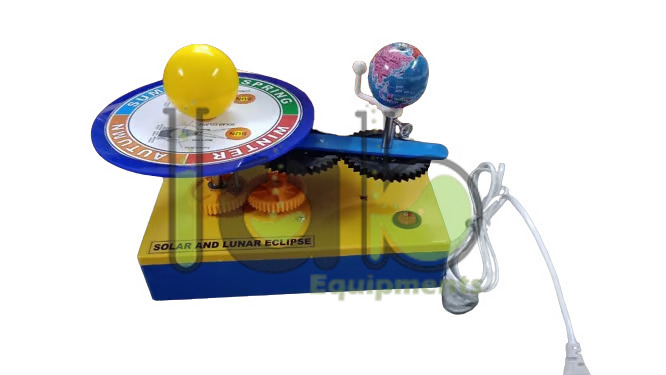
Quick Answer: Solar and Lunar Eclipse Working Model is a tabletop astronomy model that shows how the relative positions of the Sun, Earth and Moon produce solar and lunar eclipses.
Last updated: October 2026
Key Features
Shows both solar and lunar eclipse formation in one model
Solar eclipse: Moon aligned between the Sun and Earth
Lunar eclipse: Earth aligned between the Sun and Moon
Helps explain umbra, penumbra, new moon and full moon positions
Manual or motor-driven version, depending on model type
Technical Specifications
Specification
Value
Model type
Educational working model for eclipse demonstration
Displays
Solar eclipse and lunar eclipse formation
Learning topics
Sun-Earth-Moon alignment, shadow regions, orbital movement, phases related to eclipses
Operation
Manual or motorized version depending on model type
Format
Tabletop demonstration model
About This Product
The teacher identifies the Sun, Earth and Moon parts, moves the Earth and Moon according to the mechanism and uses the resulting shadow to show the difference between full and partial eclipse conditions. It also helps explain why eclipses do not happen every month, which gives this Physics Miscellaneous Products model a place in astronomy and earth science lessons.
Frequently Asked Questions
Q1. Which alignments does the model show? A solar eclipse is shown by aligning the Moon between the Sun and Earth, and a lunar eclipse by aligning the Earth between the Sun and Moon.
Q2. Does the model show shadow regions? Yes. It helps explain shadow formation and eclipse alignment, including the umbra and penumbra.

.png)

.jpeg)