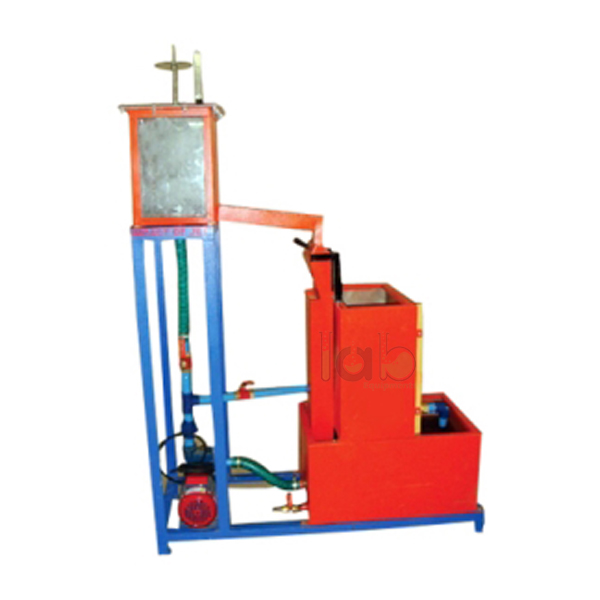
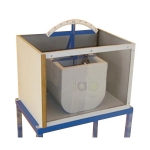
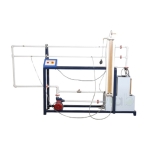
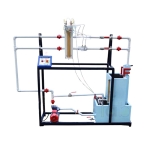
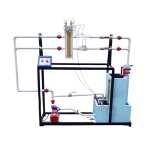
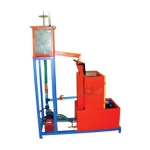
Quick Answer: Impact Of Jet On Vanes Apparatus measures the force of a water jet striking a flat plate and a hemispherical cup and compares it with the force predicted by momentum theory. The jet issues vertically from a brass nozzle inside a stainless steel chamber with glass sides.
Last updated: October 2026
Key Features
Two brass targets: flat plate and hemispherical cup
Brass nozzle discharging the jet vertically onto the target
Stainless steel chamber with two opposite sides made of glass
Weight carrier on the stem, with the dead weight of moving parts balanced by a compression spring
Measuring tank of 40 litres with piezometer, sump tank of 60 litres and FHP pump
Technical Specifications
Specification
Value
Test plates
Brass, 2 Nos.: flat plate, hemispherical cup
Nozzle
Brass
Chamber
Stainless steel, opposite sides of glass
Water circulation
FHP pump
Flow measurement
Measuring tank with piezometer, 40 litres
Sump tank
60 litres
Stop watch
Electronic
Control panel
On/off switch, mains indicator
Electricity
Single phase, 220 VAC, 0.5 kW
About This Product
The target sits on a stem that passes through the cover to a weight carrier, with a compression spring counterbalancing the dead weight of the moving parts. Weights are added to the pan until its mark lines up with the level gauge, giving the vertical force of the jet. Comparing that force with momentum theory for the flat plate and the hemispherical cup is the core exercise this engineering lab equipment in India brings to the FLUID MECHANICS LAB.
Frequently Asked Questions
Q1. How is the jet force measured? Weights are added to the weight pan until the mark on the pan corresponds with the level gauge; the added weights give the vertical force on the target.
Q2. Which targets are supplied? Two brass targets: a flat plate and a hemispherical cup.