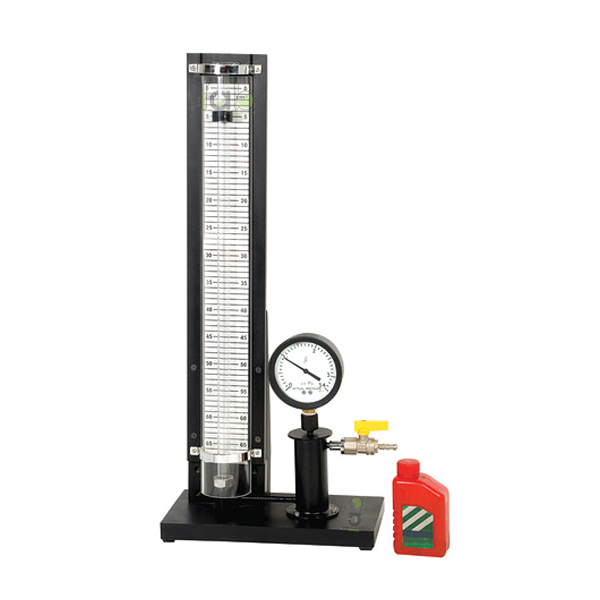
Quick Answer: Boyles Law Apparatus, Advanced with Oil shows the link between pressure and volume of trapped air. Raising the pressure in an oil chamber forces oil into a thick-walled glass tube, and air volume is read on a 0 to 65 cm³ scale.
Last updated: October 2026
Key Features
Thick-walled, wide-bore glass tube, closed at the upper end, mounted in front of a scale graduated 0 to 65 cm³
Scale zero set at the inside of the closed end, so the scale reads the enclosed air volume directly
Glass tube sealed onto a thick-walled metal tube with an O-ring for a leak-proof joint
Cylindrical oil chamber with Bourdon gauge and a side valve for an air compression pump
Transparent safety screen in front of the glass tube
Supplied without pump and oil
Technical Specifications
Specification
Value
Volume scale
0 to 65 cm³
Pressure gauge
Bourdon gauge on oil chamber
Pump connection
Side valve on oil chamber
Tube joint
O-ring on thick-walled metal tube
Safety
Transparent screen in front of glass tube
Not included
Pump and oil
About This Product
In Properties of Matter practicals the oil chamber is pressurised with an air pump, pushing coloured oil up the glass tube and compressing the air inside. The air volume and its total pressure are read directly at each step to study Boyle's law.
Frequently Asked Questions
Q1. Are the pump and oil included? No. The apparatus is supplied without the air compression pump and without oil; the pump connects through the valve on the side of the oil chamber.
Q2. How is the air volume read? The zero of the scale is at the inside of the closed end of the tube, so the oil level against the 0 to 65 cm³ scale gives the enclosed air volume directly.
Q3. What safety features does it have? The glass tube has thick walls with a very large safety overload margin, and a transparent safety screen is mounted in front of it.