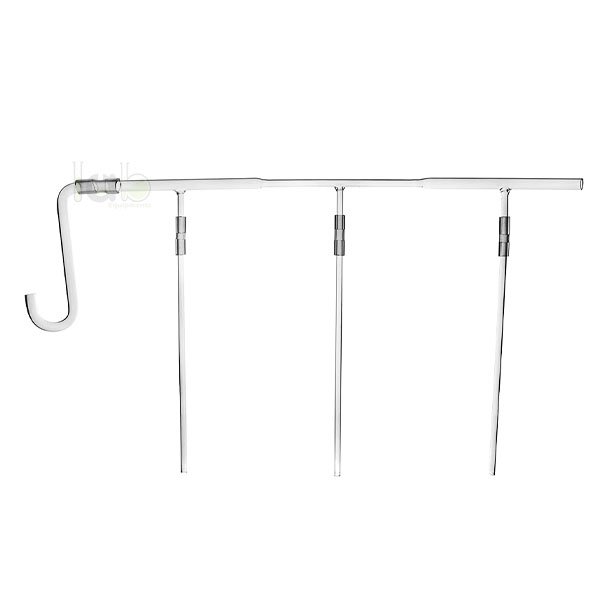
Quick Answer: Bernoulli Tube Apparatus explains Bernoulli's theorem by showing how the pressure and flow speed of an incompressible fluid change with the bore of a tube. It has two flow tubes of 500 x 13 mm, each with three side tubes for manometers.
Last updated: October 2026
Key Features
Two flow tubes, each 500 x 13 mm (L x OD)
Three sealed-in side tubes per flow tube, 25 mm long, spaced about 150 mm apart
Middle side tube rises from the central narrowed portion to show the effect of a constriction
One Bernoulli tube with central narrowing and one constant bore gradient tube
Supplied with 6 lengths of glass tubing, 2 swan-necked outlet tubes and 8 small pieces of rubber connecting tubing
Technical Specifications
Specification
Value
Flow tubes
2, each 500 x 13 mm (L x OD)
Side tubes
Three per tube, 25 mm long
Side tube spacing
About 150 mm
Glass tubing
6 lengths
Outlet tubes
2, swan-necked
Rubber connecting tubing
8 small pieces
About This Product
In Properties of Matter practicals, liquid flows through the tubes while lengths of glass tubing fitted to the side tubes act as manometers. Comparing the narrowed Bernoulli tube with the constant bore gradient tube shows how a change in cross-section alters pressure and flow speed.
Frequently Asked Questions
Q1. What does the middle side tube show? It comes out from the central narrowed portion of the Bernoulli tube, so its manometer shows the effect of the constriction on pressure.
Q2. How are the manometers made up? The 6 lengths of glass tubing are joined to the short side tubes using the 8 small pieces of rubber connecting tubing supplied with the set.



.jpg)


