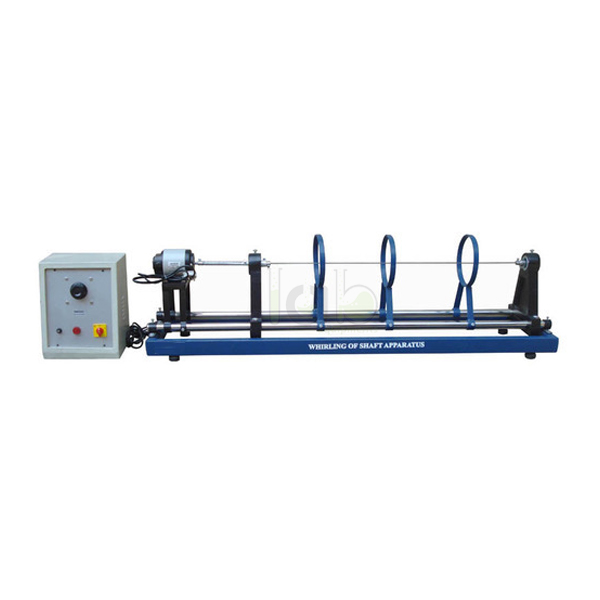
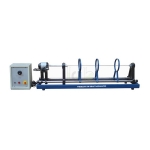
Quick Answer: Whirling Of Shaft Apparatus demonstrates the whirling of shafts carrying a single rotor, using test shafts of 4.75 mm, 6.35 mm and 7.9 mm (2 each) driven by a 1/8 HP, 1500 rpm motor under Variac control.
Last updated: October 2026
Key Features
Test shafts of 4.75 mm, 6.35 mm and 7.9 mm, 2 each, with a rotor for each shaft
Bearings for two end conditions: both ends fixed, or one end fixed and one end free
1/8 HP, 1500 rpm drive motor with Variac control
Whole unit mounted on a sturdy base
Technical manual supplied
Technical Specifications
Specification
Value
Test shafts
4.75 mm, 6.35 mm and 7.9 mm (2 each)
Rotor
One for each shaft
End conditions
Both ends fixed; one end fixed and one end free
Drive motor
1/8 HP, 1500 rpm
Motor control
Variac
Mounting
Sturdy base
About This Product
Because the test is destructive and a shaft cannot be used again afterwards, this THEORY OF MACHINE LAB apparatus is meant to demonstrate the principle rather than give repeat measurements. With a rotor on the shaft, results come closer to theory than with bare shafts, and students can see that once the whirling speed is passed the shaft starts running true again. Bearing holders on the base set the end condition for each test shaft.
Frequently Asked Questions
Q1. Which end conditions can be set on the Whirling Of Shaft Apparatus? The bearings allow both ends fixed, or one end fixed and one end free.
Q2. Why does the unit only demonstrate the principle? The test is destructive, so a test shaft cannot be used again after the test. The unit therefore demonstrates the whirling principle rather than giving repeat results on one shaft.
Q3. What happens after the shaft passes its whirling speed? It can be demonstrated that, after passing the whirling speed, the shaft again starts running true.

.png)