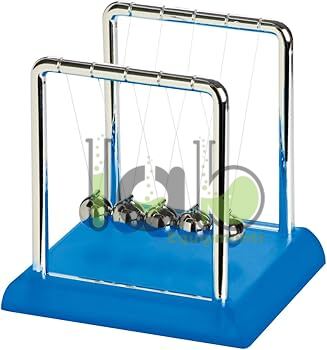
Quick Answer: Newton’s Cradle Model is a row of suspended metal balls in a frame on a support base, used to show how momentum and kinetic energy pass from ball to ball in nearly elastic collisions. One ball is lifted and released by hand.
Last updated: October 2026
Key Features
Suspended metal balls in a frame structure on a support base
Alignment arrangement keeps the balls in line at rest
Demonstrates conservation of momentum and energy transfer
Shows nearly elastic collisions between equal masses
Manually operated, no electricity needed
Technical Specifications
Specification
Value
Construction
Suspended metal balls, frame structure, support base, alignment arrangement
Working principle
Momentum and kinetic energy transferred through the balls in nearly elastic collisions
With the balls aligned and at rest, the teacher lifts one ball at the end of the row and lets it go without extra force, and the motion is passed along the line to the ball at the opposite end. This makes the cradle a simple Physics Miscellaneous Products item for lessons on momentum, collisions and conservation of energy.
Frequently Asked Questions
Q1. What does the Newton’s Cradle Model demonstrate? It shows conservation of momentum, transfer of kinetic energy and collision behaviour between equal masses in a suspended system.
Q2. How is the demonstration started? Lift one ball gently from one side of the frame and release it without applying extra force, then watch the motion pass along the row.