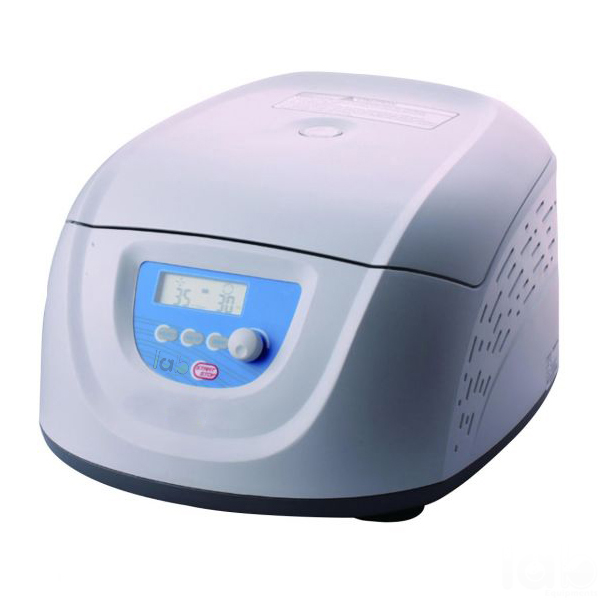
Quick Answer: Centrifuge, Clinical spins at 300 to 4500 rpm in 100 rpm increments, with a maximum RCF of 2490×g and a rotor capacity of 8 x 15 ml or 12 x 10/7/5 ml tubes, for separating serum, plasma and blood samples.
Last updated: October 2026
Key Features
300-4500 rpm in 100 rpm increments; max RCF 2490×g
Rotor capacity 8 x 15 ml or 12 x 10 ml/7 ml/5 ml
Noise level below 56 dB
CPU control with LCD showing RPM and G force
Timer from 30 seconds to 99 minutes or continuous, starting only at set speed
Pulse quick-spin mode, gentle braking, autolock lid while spinning and automatic lid release
Technical Specifications
Specification
Value
Speed
300-4500 rpm, increment 100
Max. RCF
2490×g, increment 100×g
Run time
30 sec-99 min, HOLD (continuous operation)
Driving motor
Brushless DC motor
Speed accuracy
±20 rpm
Rotor capacity
12 x 10 ml/7 ml/5 ml; 8 x 15 ml
Noise level
Less than 56 dB
Display
LCD
Safety
Autolock lid when centrifuge is spinning
About This Product
Typical uses are the separation of serum, plasma and blood samples, with the CPU controlling speed and time and the LCD showing RPM and G force. Parameters can be modified after the set speed is reached, timing only begins at that speed, and the centrifuge brakes gently to preserve the separation. Among Centrifuges, its noise level below 56 dB lets it run without becoming a disturbance in the laboratory.
Frequently Asked Questions
Q1. What tube sizes does the Centrifuge, Clinical take? The rotor takes 8 x 15 ml tubes, or 12 tubes of 10 ml, 7 ml or 5 ml.
Q2. When does the timer start? Only when the set speed is reached, so separation time is accurate; runs can be timed from 30 seconds to 99 minutes or run continuously.
Q3. Can the lid be opened during a run? No. The lid autolocks while the centrifuge is spinning and releases automatically when the process is finished.
Lab Equipments Ambala supplies institutions and distributors in Benin, Namibia, Georgia and the Solomon Islands, as part of its export work to 80+ countries.