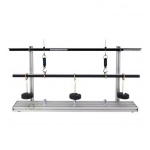
Quick Answer: Hanging Tubular Spring Balance is a force-measuring instrument with a tubular body that indicates weight, pull and tension from the extension of a calibrated spring.
Last updated: October 2026
Key Features
Hanging format for suspended loads, pull force and tension
Tubular spring-balance body
Works on spring extension under applied load
Used in friction, pulley, inclined plane and hanging-load practicals
Supports basic Hooke's law load-extension activities
Technical Specifications
Specification
Value
Measurement function
Force, weight, pull and tension measurement
Operating principle
Spring extension under applied load
Body type
Tubular hanging spring-balance body
About This Product
Hung vertically from a support, the balance is checked for zero, loaded through the lower hook and read at eye level once the load stops swinging. Students in Applied Mechanics practicals use this piece of mechanics lab equipment to compare mass, weight and force and to record readings for friction, pulley and inclined plane experiments.
Frequently Asked Questions
Q1. How should students read the Hanging Tubular Spring Balance? Suspend it vertically, check that it reads zero before loading, avoid swinging or jerking the load, and read the scale at eye level.
Q2. Can the spring balance be used for Hooke's law experiments? Yes, it can support Hooke's law and load-extension activities as long as the load stays within the balance's capacity.

.jpg)

.jpg)
.jpeg)