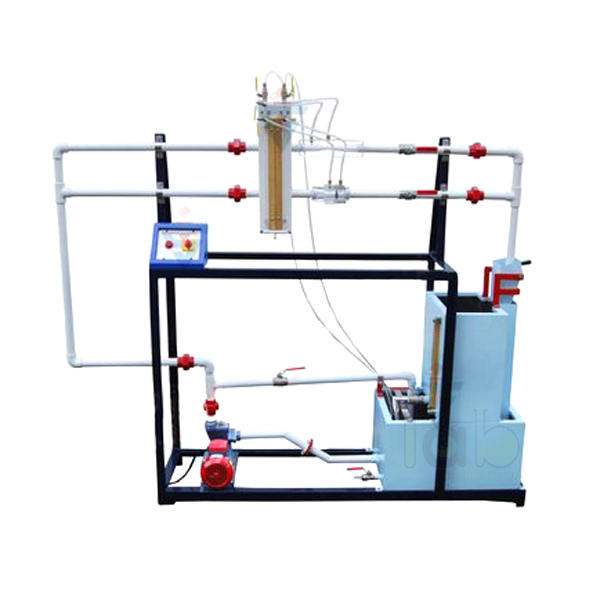
Quick Answer: Study Of Pipe Fitting is a self-contained water re-circulating set-up for measuring the loss of head and the loss coefficient of common pipe fittings, including a sudden enlargement from 15 mm to 25 mm and a sudden contraction from 25 mm to 15 mm.
Last updated: October 2026
Key Features
Fittings under test: bend, elbow, sudden enlargement, sudden contraction, ball valve and gate valve
Sudden enlargement 15 mm to 25 mm; sudden contraction 25 mm to 15 mm
Pressure tappings at inlet and outlet of each fitting with a differential manometer
Sump tank of 50 litres and FHP pump with flow control and by-pass valves
Measuring tank of 25 litres with piezometer and electronic stop watch
Technical Specifications
Specification
Value
Sudden enlargement
From 15 mm to 25 mm
Sudden contraction
From 25 mm to 15 mm
Bend / elbow
½
Ball valve / gate valve
½
Water circulation
FHP pump
Flow measurement
Measuring tank with piezometer, 25 litres
Sump tank
50 litres
Stop watch
Electronic
Electricity
Single phase, 220 V AC, 0.5 kW
About This Product
The differential manometer in the line gives the pressure loss across each fitting, while the flow control and by-pass valves set a range of flow rates. Timing the measuring tank gives the discharge, so students in the FLUID MECHANICS LAB can relate head loss to flow for every fitting and work out its loss coefficient.
Frequently Asked Questions
Q1. Which fittings can be tested? A bend, an elbow, a sudden expansion and a sudden contraction between 15 mm and 25 mm, a ball valve and a gate valve.
Q2. How is the loss across a fitting measured? Pressure tappings at the inlet and outlet of each fitting connect to a differential manometer in the line, which gives the pressure loss of the individual fitting.
Lab Equipments Ambala packs and ships export orders for buyers in Lithuania, Papua New Guinea and Trinidad and Tobago.