Quick Answer: Kinetic Theory Apparatus demonstrates the kinetic theory of gases, and effects such as the thinning of air with altitude, using 1/8 inch metal spheres set moving on a rubber diaphragm by a DC motor-driven piston.
Last updated: October 2026
Key Features
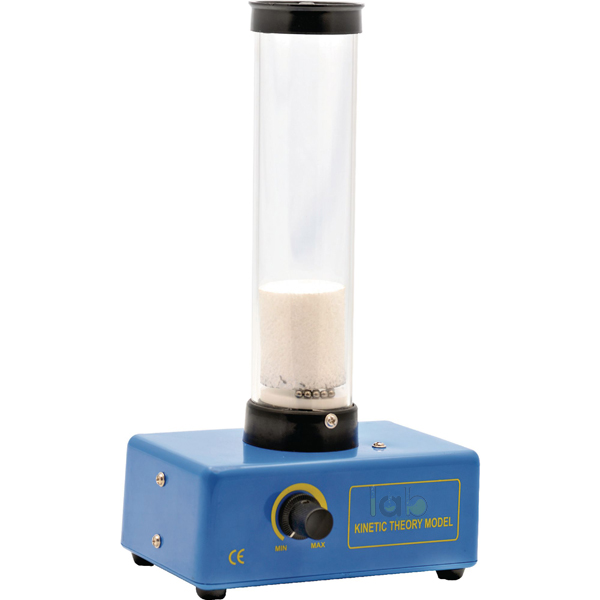
Transparent cylindrical plastic tube with a rubber diaphragm at the lower end and a cap with holes at the upper end
Metal spheres of 1/8 inch diameter placed on the diaphragm
Piston below the diaphragm, driven by a DC motor, agitates the spheres
Tube held in a ring with three equally spaced tightening screws
Two 4 mm socket terminals on the base for the motor connection
Technical Specifications
Specification
Value
Tube
Transparent cylindrical plastic, rubber diaphragm, cap with holes
Spheres
Metal, 1/8 inch diameter
Drive
Piston connected to DC motor
Terminals
Two 4 mm sockets
About This Product
In Properties of Matter lessons the motor is connected through the base terminals, and the agitated diaphragm keeps the spheres moving inside the tube. Their motion is used to illustrate the kinetic theory and the thinning of air with increasing altitude.
Frequently Asked Questions
Q1. What sets the spheres moving? A piston below the rubber diaphragm, connected to a DC motor, agitates the 1/8 inch spheres resting on the diaphragm.


 (1).png)